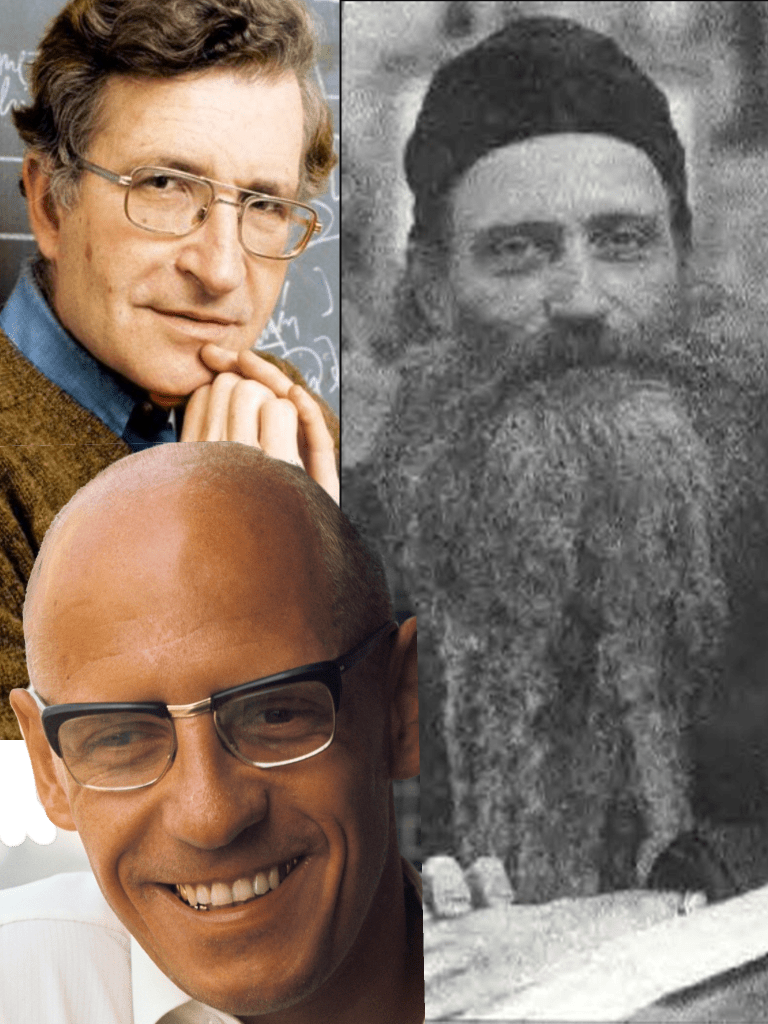
I want to say at the outset that this post is not indicative of just how long and how agonizing it was for me to begin to understand Orthodox Christianity’s response to Nihilism. For one thing, I was unaware as to how pervasive outright Nihilism was in the West until reading Fr. Seraphim Rose’s book, Nihilism: the Roots of the Revolution of the Modern Age. I highly recommend reading Fr. Rose’s book and beginning the journey for yourself. It will take time, it will be difficult, but it will ultimately be for your own good.
I recommend watching the video above before going on with the rest of this post. The video is a thirteen minute clip from a 1971 debate between two of the world’s most renowned academicians: Noam Chomsky and Michel Foucault.
______
This debate highlights a very important question: Do humans have a universal nature, and if they do, can it be known?
Most of the debate revolved around each person’s perspective on what constitutes the structure of societies and what determines the rights, freedoms, and justice for the people that live in those societies. Foucault believes the fundamental structure of society is ordered by the will of the powerful elites to perpetuate their own desires from the top of the structure. Chomsky believes that the structures themselves, while being imperfect, are the development of genuine attempts to create fair systems of justice and freedom according to the fundamental rights due to human beings according to their nature. Foucault takes a pessimistic view (human nature is undiscoverable and possibly non-existent), while Chomsky takes an optimistic view (human nature is real, universal, and can be revealed to create better societies).
Chomsky believes that humanity’s pursuit of justice is a result of a universal human nature, but Foucault, as you saw, wants him to define human nature, which Chomsky cannot do. Instead he appeals to a hope-filled notion that someday scientists will finally isolate the essence of humanity that has been hidden in a universal ideal for so long. This is, of course, completely unscientific and nothing more than wishful-thinking cloaked in typical academic language of the naive empiricist, and Foucault exposes it. But to Chomsky’s credit, and even though he has absolutely no good reason to believe this, he sticks to his guns and maintains that human beings have a nature, and since they have a nature, morality, truth, justice, and freedom are aspects of society that should be determined by that nature.
Foucault takes Chomsky’s optimism to task when he states, “As I think you recognized at the outset we don’t know what human nature is.” This statement, which Chomsky agrees with, presents a serious problem for Chomsky in that the presupposition of his whole argument regarding the belief that the structure of societies are ordered according to a universal human nature is ultimately something he can’t define, describe, or understand. Nevertheless he states, “[I believe there is] an absolute basis residing in fundamental human qualities in terms of which a real notion of justice is grounded… I think systems of justice [can] embody elements of oppression, but they also embody a kind of groping towards the true humanly valuable concept of justice and decency and love and kindness and sympathy and so on.”
Foucault, however, rejects the notion of the universal ideal of human beings groping for the revelation of their objective human nature. Life has no inherent meaning according to Foucault, for the Nihilist believes we are nothing more than primordial goo with no purpose or “higher calling” that is distinct from our individual desires. Objectivity is nothing but a fabricated tool fashioned and used by the powerful elites within a societal structure to propagate their own agenda.
Foucault thinks Chomsky’s view is wrong because what constitutes justice and freedom according to human nature will be inevitably determined by powerful elites who themselves define human nature. He even quotes Mao to highlight his criticism that societies and those who control them will invent their own definitions of what constitutes human nature, and thereby, what rights and freedoms individuals are to have according that particular nature when he devastatingly remarks, “Mao spoke of bourgeois human nature and proletarian human nature.”
This is a powerful critique of Chomsky’s position because it perfectly demonstrates the relativism within his argument. Chomsky believes Mao’s definition of human nature was wrong, while simultaneously asserting that he doesn’t know what human nature is.
Another aspect to Foucault’s critique of Chomsky’s naive empiricism reveals the impossibility of discovering human nature by means of data collection. No one is ever going to do a science experiment and uncover the true essence of what constitutes human nature, and therefore, neither will they ever be able to know the rights, morals, and freedoms for which human beings are purposed. No human being will discover universal human nature because it is not there.
Foucault is also equally foolish when he insists that there is no universal human nature determining the meaning of existence, which means each human being has the ability to will their own meaning.
I’ll write that again just to see if you pick up the irony of his beliefs: there no universal human nature determining the MEANING of existence, which MEANS each human being has the ability to will their own MEANING.
Either meaning exists or it doesn’t. Either the world is structured and ordered according to a pattern or it isn’t. If there is no meaning to your existence, then you do not get to determine the meaning of your existence anymore than a doorknob gets to determine the meaning of its existence.
What neither man is willing to face is the fact that if divine revelation does not exist, and if a creator does not exist, then an inherent purpose within particular natures also do not exist. This immediately refutes Chomsky, but not necessarily Foucault. In the godless world, nothing has meaning and nothing has purpose. Logic, the foundation by which anything becomes intelligible at all also does not exist. Order at every level of reality is an illusion of our chemically enslaved brains. Free-will does not exist because you are merely a clump of cells “happening.” Language means nothing, which, of course, means the debate these two men are having is completely ridiculous an meaningless, and in fact, the product of nothing more than their chemically constrained synapses bursting about inside their skull, independent of the illusion of control Chomsky and Foucault think that they have. If god is not there, then Chomsky is refuted. His presuppositions of universals regarding humanity require a universal organizer, pattern maker – a creator.
Chomsky’s conclusion that humans have a nature and are therefore due particular rights, freedoms, and justice according to that nature is nothing more than a delusion which betrays his own atheistic presuppositions. With absolutely no justification or basis he states, “its of critical important that we have some direction…” According to who, Chomsky? According to you? Why does it matter? What is suffering in a world with no meaning? These questions are not arbitrary.
Foucault, in this debate, perfectly annihilates Chomsky’s assertion that universal human nature can be found in the world as though it were a flower in a field – a flower no one has seen, in a field yet to be found – just waiting to be examined. Thus, for Foucault, meaning is defined by those who will it into being, which is equally stupid.
The irony is that this nihilistic conclusion of Foucault is actually what Chomsky’s worldview indicates that he believes. The super-smart, high IQ scientists (powerful elites) are the ones who will take us into the future that humanity deserves, because it is only those people who have the power to tell everyone else (powerless) what the meaning of our lives are. But instead of just being consistent with his own presuppositions, as Foucault was trying to get him to do, he maintains the same materialist, atheist delusion that meaning and order do not exist, and yet order exist so much that we can replicate it and observe it at every level of existence with the scientific method, a method by which we will eventually discover the universal principles constituting human nature, and when we do, the golden tablet of right and wrong will finally be revealed.
In the end, each person is half right:
Chomsky is right to suggest that human beings have a universal nature – an essence – that fundamentally defines the meaning and purpose of human life, and is thereby illustrative of what constitutes the morality, justice, and freedom appropriate to their nature. Chomsky is wrong, because he foolishly believes this universal essence is created and defined… by meaningless, patternless, unintelligible nature…
Foucault is right in his critique of Chomsky (and thereby Modernity) that human nature isn’t something that is ever going to be stumbled upon in some science experiment, and that as long as men like Chomsky believe they can find and define human nature, they will inevitably define human nature, morality, rights, and justice according to what best serves the purposes of the people in control. This inevitably leads Foucault to Nihilism, because for him, there is no order in the world, there is no universal nature in human beings, or anything else for that matter, and there is no creator. The only thing that exists is the will to power.
Neither worldview acknowledges the legitimacy of divine revelation because both men are atheists. Because of this, both Foucault and Chomsky and halfway right, but mostly, they’re wrong and just flat out ignorant of Christian thought on metaphysics, epistemology, and reality in general.
In the end, this is the what happens when God is abandoned. Christianity is the story of God’s creative power to form and “hold together” the very order by which all things “live and move and have their being.” The principles of logic and mathematics, the purpose for which human beings have been made, the structure of reality itself cannot be accounted for unless it’s origination is from a creator that is beyond being itself and beyond material itself. This patterning and order in the universe, along with the immaterial aspects of reality that make it intelligible to us, refutes Foucault, for their existence means that there is such a thing as the way things ought to be according to their universal nature. For example, seven is always seven no matter what. Seven operates, without fail, according to its universal nature. Human beings, in the Christian story also have a way they ought to be according to their nature, but humans have free-will, which allows us to take a different path – to live as we ought not live.
Human Beings do have a universal nature, and the morality, justice, and freedom of human beings is defined by the divine revelation that human life has been formed and ordered in the image and likeness of God, the creator, who is the one giving form and order to everything that exists. How can there be such continuity (pattern/order/meaning/purpose) in a world of such distinct substances? The only answer must be that the one who creates the forms maintains the pattern.
Orthodox Christianity and the divine liturgy that is celebrated in orthodox churches every sunday is the mystery of the heavenly pattern becoming revealed in the earth, just as the eternal Word of God did 2000 years ago. All senses are raptured to the heavenly place as the divine meets with the material. This participation serves to form the hearts and minds of the people of God to become aware of these patterns in the world. Without them, we are lost and left with only one nihilistic reality: nothing matters, nothing exists, and neither do you. But you do exist, because each of us are fearfully and wonderfully made in the image and likeness of God himself, prepared for a body like the glorified Christ, if only by Grace we will obtain it one day.
Do not be fooled by men in suits with papers on their office walls that say “Doctor of Philosophy”, because it doesn’t mean their worldviews make any sense at all. Neither of these men are able to give an account for anything around them.
They cannot account for the immaterial, yet they operate under the assumption of its existence.
They cannot give an account of human nature, yet they believe it exists apart from any “evidence.”
They cannot give a coherent account of what constitutes right or wrong, yet they all have fundamental presuppositions that right and wrong are important for life.
They cannot give an account for truth or its existence, yet the whole academic enterprise is based on revealing what is true.
They cannot give an account of free-will, yet all of them believe that what they are doing is being done based on a meaningful choice they made to do so.
They cannot give an account of rights, yet somehow they’re so important they take precedence in all matters of public and private life.
They cannot give an account of the possibility of knowledge, yet they believe knowledge can transmitted and understood.
They cannot give an account for existence at all, yet they believe their life has meaning.
Nevertheless, there they were, talking ad nauseum about their perspectives on society, human nature, and right and wrong.
Once these things were pointed out to me, and my eyes were opened to just how absurd the presuppositions undergirding these philosophies are, I immediately began to see how the patterning of the world really is explained in the Orthodox Christian paradigm. If the universe is held together in unity by a God who is himself perfectly unified, then there really are things like truth, beauty, right, and wrong. There really is a pattern of being. This pattern-of-being is not up to you to create for yourself, as Foucault would have you believe, and it’s not something you’ll stumble on in a science experiment, as Chomsky would have you believe.
This extends to Christian worship as well; It is not up to you to decide what “pattern” or style of worship you choose to participate in. God has revealed the right way to worship to his church based on the pattern of worship revealed to Moses, which was itself based on the pattern of worship in Heaven. We are, in every way, subjected to the patterns by which God has constructed all things. When we refuse to live according to those patterns, we die.

 cosmicmystagogy.com
Leave a comment